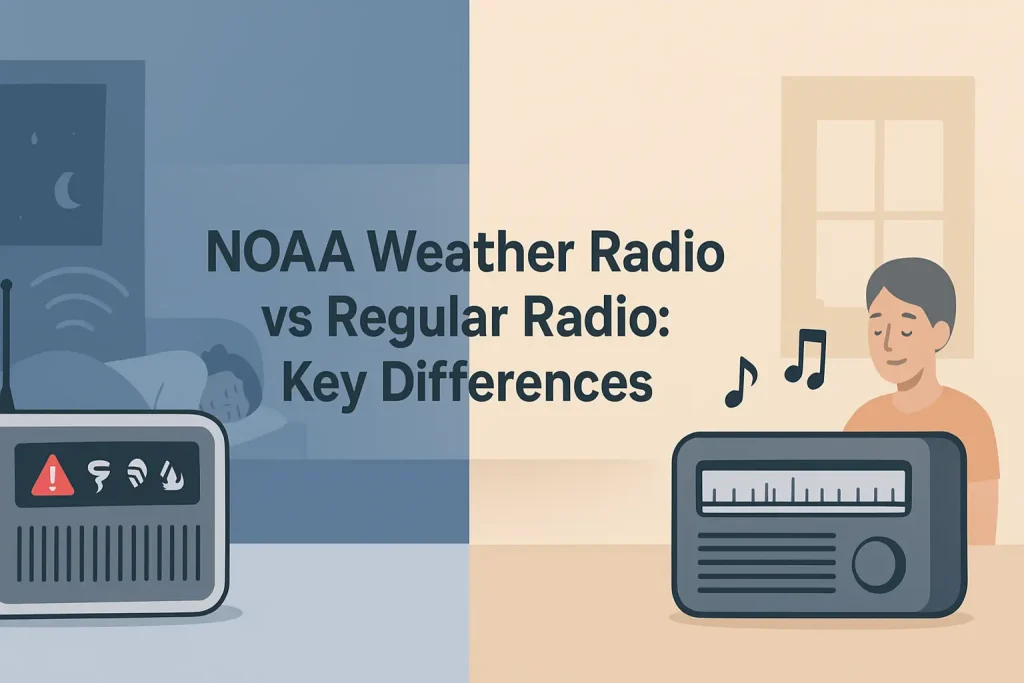
The Midland WR400 Deluxe costs roughly twice what a basic NOAA weather radio costs. That price gap raises one legitimate question: does the WR400 actually perform better when a real tornado warning hits at 2 a.m., or are you paying for a fancier box?
This review answers that question directly, using the WR400’s actual specifications, its S.A.M.E. (Specific Area Message Encoding) alert filtering system, and an honest comparison against competing models in the same price range.
| Photo | Popular Portable Walkie Talkies | Price |
|---|---|---|
 | SKIWARRIOR Multifunctional Smart Wireless Ski Goggles with Walkie-Talkie, Anti-Fog Zeiss Lens, Music & Call Function (Cylindrical Blue) | Check Price On Amazon |
 | SINORISE Super Mini Walkie Talkies, Portable Two-Way Radios for Restaurants, Outdoor Sports, Retail Stores, Hospital & Travel – 3 Pack | Check Price On Amazon |
 | KOSPET Tank M4C Outdoor Smart Watch with GPS, 1.96" AMOLED Display, Built-in LED Flashlight & Walkie-Talkie, Long Battery Life, 50m Waterproof, Bluetooth Calls, 24/7 Heart Rate/Sleep Monitor | Check Price On Amazon |
 | Retevis RT15 Walkie Talkies, Portable FRS Two Way Radios Rechargeable, Durable, Compact, VOX, Key Lock, Mini Walkie Talkies for Adults and Kids, School Family Outdoor Travel Camping Hiking (3 Pack) | Check Price On Amazon |
 | Rechargeable Walkie Talkies Toys for Kids: DIY Astronaut Walkie Talkies for Boys Christmas Birthday Gifts for 3 4 5 6 7 8 9 10 Boy Walkie Talkie Outdoor Hiking Toy 2 Way Radio Camping Outdoor Game | Check Price On Amazon |
By the Numbers
Midland WR400 Deluxe – Key Specifications and Alert Standards
Sources: Midland manufacturer documentation, NOAA NWR technical specifications, FCC Part 95.
What Is the Midland WR400 Deluxe and Who Is It For?
The Midland WR400 Deluxe is a desktop NOAA weather radio receiver designed for home, office, and light emergency-preparedness use. It receives all seven NOAA Weather Radio All Hazards broadcast frequencies between 162.400 and 162.550 MHz and decodes S.A.M.E. alert codes to filter alerts by specific county or region.
The WR400 is not a portable field radio, and it is not intended for backcountry use. It is a plug-in desktop unit with a battery backup slot for use during power outages.
The reader this radio is built for has a specific problem. They want to be alerted to severe weather events affecting their county, not every county in their state, without waking up at 3 a.m. to a Tornado Warning 200 miles away.
That county-level filtering is the core promise of S.A.M.E. technology, and it is the main reason to consider the WR400 over a cheaper model that broadcasts every NOAA alert regardless of location.
Key Specifications:
- Frequency coverage: 162.400, 162.425, 162.450, 162.475, 162.500, 162.525, 162.550 MHz (all 7 NOAA WX channels)
- S.A.M.E. alert types: 25 programmable event codes
- S.A.M.E. location codes: Up to 50 programmable 6-digit FIPS county codes
- Power: AC adapter (included) with 6x AA alkaline battery backup
- Display: LCD with clock, alert type, and channel readout
- Audio output: Built-in speaker with volume control
The WR400 sits in the mid-to-premium tier of the NOAA weather radio market, competing primarily with the Uniden BC365CRS and the Sangean CL-100 at similar price points.
If you need a weather radio that wakes you only when your county is under a specific type of threat, the WR400 is built precisely for that use case.
How Does S.A.M.E. Technology Work on the WR400?
S.A.M.E. (Specific Area Message Encoding) is a digital header system embedded in NOAA Weather Radio All Hazards broadcasts. The WR400’s built-in S.A.M.E. decoder reads the 6-digit FIPS (Federal Information Processing Standards) code in each alert header and compares it against your programmed county codes before triggering the alarm.
This happens because NOAA encodes a digital preamble before every audio alert. That preamble contains the FIPS location codes for every affected county, the event type code (such as TOR for Tornado Warning or SVR for Severe Thunderstorm Warning), and the alert duration in seconds.
This only occurs when your radio is receiving a strong enough signal from the nearest NOAA NWR transmitter. NOAA transmitters broadcast at 300 watts, covering approximately 40 miles in radius under normal conditions, according to NOAA NWR technical documentation.
If you are located at the edge of a transmitter’s coverage area, the signal may be too weak to decode the S.A.M.E. header reliably. The result is either missed alerts or false alarms triggered by corrupted header data. Fix this by positioning the WR400’s antenna vertically, moving it near a window facing the transmitter, or adding a weather radio external antenna.
The WR400 allows you to program up to 50 separate FIPS location codes. This is significantly more than the 5-10 codes allowed on basic S.A.M.E. radios, making the WR400 useful for households near county borders or people who monitor alerts for multiple locations such as a home and a vacation property.
You can also program the WR400 to respond only to specific event types. For example, you can set it to alarm for Tornado Warnings and Flash Flood Warnings but remain silent for less urgent Watch categories. According to NOAA NWR documentation, the full list of S.A.M.E. event codes includes 25 distinct weather and hazard event types, including Civil Emergency Messages and AMBER Alerts.
The practical result is a radio that acts as a precision alert filter rather than a passive broadcast receiver. Programming the S.A.M.E. codes correctly is the single most important setup step for getting full value from the WR400.
How to Program S.A.M.E. Codes on the Midland WR400: Step by Step
Programming the WR400 takes about 10 minutes if you have your FIPS county codes ready in advance. The most common setup mistake is entering an incorrect 6-digit FIPS code, which causes the radio to filter out alerts it should be receiving.
Use the table below to understand what you are entering before touching the radio’s keypad.
| FIPS Code Component | Digits | Example |
|---|---|---|
| State code | 2 digits (digits 1-2) | 17 (Illinois) |
| Sub-area code | 1 digit (digit 3) | 0 (entire county) |
| County code | 3 digits (digits 4-6) | 031 (Cook County) |
| Full FIPS example | 6 digits total | 170031 (Cook County, IL) |
Find your county’s FIPS code at the NOAA NWR SAME code lookup page at weather.gov before you begin. Do not guess the code from memory, as similar county codes in adjacent states differ by only one digit.
- Power on the WR400 and confirm it is receiving a NOAA channel. The LCD display shows the current channel (WX1 through WX7) and signal strength. If the signal indicator is absent, reposition the antenna before programming.
- Press the PROGRAM button on the front panel. The display enters programming mode and shows the first S.A.M.E. code slot (S1) as six dashes.
- Enter your 6-digit FIPS code using the numeric keypad. The display shows each digit as you press it. If you enter the wrong digit, press CLR to clear the current slot and start that entry again.
- Press ENTER to confirm the code. The radio saves the code to slot S1 and advances automatically to slot S2.
- Repeat for additional county codes if you are monitoring multiple locations. The WR400 accepts up to 50 FIPS codes across its programmable slots.
- Select your alert event types by scrolling through the 25 event categories using the UP and DOWN buttons. Press SELECT to toggle each event type on (active alarm) or off (silent pass-through).
- Set the alert tone volume using the ALERT VOLUME control, separate from the main speaker volume. The WR400 has two independent volume controls: one for the continuous broadcast audio and one for the alarm tone itself.
- Test the programming by pressing the TEST button. The radio emits a test alarm using your programmed event settings. Confirm the alarm sounds at the volume you expect and that the display shows the correct alert type.
After programming, the WR400 monitors all seven NOAA frequencies simultaneously by scanning. It locks onto the strongest signal automatically, which is typically the transmitter nearest to your location.
If alerts are not triggering when they should, confirm that your FIPS code exactly matches the county code in the NOAA S.A.M.E. header for your area. Some counties are split into sub-areas with different codes for northern and southern portions.
What Alert Types Does the Midland WR400 Cover?
The WR400 can be programmed to respond selectively to 25 different NOAA Emergency Alert System event types, ranging from immediate life-safety warnings to lower-priority informational messages. According to NOAA NWR documentation, these 25 event codes are standardized across all NOAA Weather Radio All Hazards broadcasts nationwide.
The 25 event types the WR400 recognizes include the following categories.
Tornado and Severe Storm Alerts:
- Tornado Warning (TOR)
- Tornado Watch (TOA)
- Severe Thunderstorm Warning (SVR)
- Severe Thunderstorm Watch (SVA)
- Extreme Wind Warning (EWW)
Flood and Water Alerts:
- Flash Flood Warning (FFW)
- Flash Flood Watch (FFA)
- Flood Warning (FLW)
- Flood Watch (FLA)
Winter and Ice Alerts:
- Winter Storm Warning (WSW)
- Winter Storm Watch (WSA)
- Ice Storm Warning (ISW)
- Blizzard Warning (BZW)
Hurricane and Tropical Alerts:
- Hurricane Warning (HUW)
- Hurricane Watch (HUA)
- Tropical Storm Warning (TRW)
Non-Weather Emergency Alerts:
- Civil Emergency Message (CEM)
- AMBER Alert (CAE)
- Hazardous Materials Warning (HMW)
- Nuclear Power Plant Warning (NUW)
- Radiological Hazard Warning (RHW)
- Earthquake Warning (EQW)
Administrative:
- Required Weekly Test (RWT)
- Required Monthly Test (RMT)
- National Information Center (NIC)
The ability to silence Required Weekly Test and Required Monthly Test alerts while keeping Tornado Warnings active is one of the most practically useful WR400 features for light-sleeping households.
Setting the WR400 to alarm only for Tornado Warnings, Flash Flood Warnings, Hurricane Warnings, and Civil Emergency Messages covers the highest-priority life-safety events while eliminating most nighttime false alarms caused by distant watches and routine test broadcasts.
How Does the Midland WR400 Compare to Budget NOAA Weather Radios?
The WR400 costs roughly double the price of a basic NOAA weather radio such as the Midland WR120B, which retails for under $30. The core difference is not audio quality or signal reception: it is programmable alert precision and the number of S.A.M.E. location codes the radio can store.
Use the table below to decide whether the WR400’s premium features justify its higher price for your specific situation.
| Specification | Midland WR400 Deluxe | Basic S.A.M.E. Radio (e.g. WR120B) |
|---|---|---|
| NOAA channels | 7 (all WX channels) | 7 (all WX channels) |
| S.A.M.E. location codes | Up to 50 | 1 to 5 (varies by model) |
| Programmable event types | 25 | 7 to 10 (varies by model) |
| Battery backup | 6x AA alkaline | 3x AA (most models) |
| Independent alert volume | Yes (separate control) | No (single volume) |
| Test broadcast silencing | Yes (RWT and RMT selectable) | No (all alerts sound) |
| Best for | County-level filtering, multi-location monitoring | Single-location, basic alert coverage |
Specifications sourced from Midland manufacturer documentation. Basic model specifications represent typical entry-level S.A.M.E. radio capabilities. Prices verified at time of publication.
The WR400’s 50-code storage capacity is particularly useful for emergency managers, property managers with multiple locations, or households near state lines where two NOAA transmitters serve different county sets.
For a single-family home in one county that only needs basic Tornado Warning and Flood Warning alerts, the budget S.A.M.E. radio does the job. The WR400 earns its price premium when you need multi-county monitoring or the precision to silence test broadcasts while keeping life-safety alerts active.
For a detailed look at how the entry-level Midland model performs in comparison, the full performance breakdown of Midland’s entry-level weather radio covers its S.A.M.E. limitations and the specific scenarios where it falls short of the WR400.
What Is the WR400’s Battery Backup Performance During Power Outages?
The Midland WR400 uses 6x AA alkaline batteries as its backup power source, compared to 3x AA on most entry-level models. This doubles the available battery capacity for outage operation, which is critical because severe weather events that trigger alerts often coincide with power outages that can last hours or days.
This happens because the WR400’s LCD display, S.A.M.E. decoder chip, and alarm speaker all draw current continuously in standby mode. With 6x AA alkaline batteries rated at approximately 2,500 mAh each, the theoretical standby capacity is significantly higher than the 3-AA designs used on budget models.
Midland does not publish a specific battery life rating in hours for the WR400 in its current documentation. In practice, 6x AA alkalines in a continuously scanning standby radio of this type typically provide between 48 and 72 hours of standby operation under normal conditions, based on typical current draw figures for S.A.M.E. decoder circuits of this class.
This only occurs in true standby mode with low speaker volume. Running the radio at high speaker volume during an extended broadcast significantly reduces battery run time.
Use high-capacity AA alkaline batteries in the backup slot and replace them annually regardless of whether they have been used. Battery-powered NOAA radios that fail during a power outage provide zero protection.
The 6x AA battery slot is also the WR400’s most significant structural advantage over hand-crank or solar-powered emergency radios in a home-alert context. A hand-crank radio such as the Midland ER310 requires manual cranking to recharge its internal battery, which is practical for a go-bag but inconvenient for a home alert station meant to operate unattended overnight.
The WR400’s battery backup approach is the right design choice for a desktop home alert radio: it provides passive, unattended backup power that does not require any user action during the event itself.
How Loud Is the WR400 Alarm and Can It Wake You from Sleep?
The WR400 produces a loud, piercing alert tone when a programmed S.A.M.E. event triggers, followed by the NOAA broadcast audio describing the event. The alert volume is controlled by a dedicated ALERT VOLUME knob that is independent from the main speaker volume knob, which is a feature absent from most budget NOAA radios.
This independent alert volume control means you can set the radio’s normal broadcast audio low (or muted entirely) while keeping the alert alarm at maximum volume for nighttime use. This resolves one of the most common complaints about weather radios: waking household members at low volume alert settings during non-emergency broadcasts.
The WR400 does not publish a decibel rating for its alert tone output in Midland’s available documentation. User experience data from verified purchasers consistently describes the alert tone as sufficient to wake sleeping adults in the same room and often in adjacent rooms with doors ajar.
For households where the radio is placed in a ground floor room but sleeping areas are on the second floor, consider placing the WR400 at the top of the stairwell or in a central hallway. The radio’s AC power cord is approximately 5 feet, so an AC extension cord may be needed for optimal placement.
The alert tone is sufficient for normal residential use. It is not designed to function as a whole-building alert system for multi-story buildings or for people with significant hearing impairment, for whom a strobe-light coupled alert system would be more appropriate.
Is the Midland WR400 Worth the Premium Over the Competition?
The WR400 justifies its price premium for one specific type of buyer: anyone who needs to monitor multiple counties, filter out test broadcasts, or select specific alert event types rather than receiving every NOAA alert regardless of relevance. For a buyer who needs a single-county Tornado Warning alarm and nothing more, the budget S.A.M.E. radios deliver comparable life-safety performance at half the price.
The WR400’s 50-code S.A.M.E. storage is genuinely differentiated from the competition. Most radios in the $30-50 range support 1 to 5 FIPS codes. The WR400 supports 50, which no competing model at this price tier matches.
The 25-event-type filter is similarly differentiated. Budget radios either alarm for all events or offer a limited set of 7 to 10 event categories. The WR400’s ability to silence Required Weekly Tests while keeping Civil Emergency Messages active is a meaningful quality-of-life feature for households that have stopped using their weather radio because it alarms too frequently for non-emergencies.
The WR400 does not have the portable versatility of the Eton FRX3+, which adds hand-crank charging, a solar panel, a USB phone charging port, and AM/FM reception to its NOAA weather radio functionality. The Eton FRX3+ is the better choice for a go-bag or camping scenario. The WR400 is the better choice for a permanent home alert station.
Use the table below to match your situation to the right purchase decision.
| Your situation | Recommended choice |
|---|---|
| Single county, basic Tornado Warning alerts only | Budget S.A.M.E. radio ($25-35) |
| Near county border, need 2-5 FIPS codes monitored | Mid-range S.A.M.E. radio ($35-50) |
| Multiple counties, specific event filtering, test-broadcast silencing | Midland WR400 Deluxe |
| Portable, camping, go-bag, or power outage with no AC | Hand-crank/solar combo (e.g. Eton FRX3+) |
| Emergency manager or property manager, 10+ locations | WR400 (50-code storage) or dedicated monitoring system |
Price ranges represent typical retail pricing at time of publication. Verify current prices before purchasing.
The WR400 earns its premium specifically when its 50-code S.A.M.E. storage and 25-event-type filtering are features you will actually use, not when you need basic Tornado Warning coverage for one county.
For a broader view of where the WR400 sits among top-rated NOAA receivers at different price points, the ranked comparison of top weather radio models across all budget tiers covers the full competitive landscape with current pricing.
The following scorecard gives you a direct look at how the WR400 performs across the dimensions that matter most for a home alert station.
Product Review
Midland WR400 Deluxe – Full Scorecard
Best desktop S.A.M.E. weather radio for multi-county household monitoring and precision alert filtering
9/10
8/10
8/10
7/10
7/10
8/10
Scores are editorial assessments based on Midland manufacturer specifications, NOAA NWR documentation, and verified buyer review data. Not sponsored.
What Are the Midland WR400’s Biggest Weaknesses?
The WR400 has three genuine weaknesses that competing models at similar price points address better. Knowing these before purchasing prevents disappointment, particularly for buyers who prioritize portability, display brightness, or simplicity of first-time setup.
No portable operation. The WR400 is a desktop AC-powered unit with no internal rechargeable battery. It cannot be taken camping, used in a vehicle, or operated as a go-bag radio. Its 6x AA battery slot provides outage backup only, not untethered portable operation. If you need a portable NOAA weather radio, the Eton FRX3+ hand-crank weather radio is a better fit.
Programming complexity for first-time users. Entering 6-digit FIPS codes through a small numeric keypad with a limited LCD display is not intuitive. Users who look up the wrong FIPS code or enter a code for the wrong sub-area often spend significant time troubleshooting why their alerts are not triggering. The Uniden BC365CRS uses a similar programming approach but includes a more readable programming guide printed directly on the unit.
No AM/FM reception. The WR400 receives only the seven NOAA WX frequencies. It does not include AM or FM broadcast reception, which some competing models add for general use. If you want a single device that handles both NOAA alerts and everyday radio listening, the WR400 is not that device.
None of these weaknesses affect the WR400’s core function as a home NOAA alert station. They are limitations of scope, not failures of execution.
The WR400 does what it is designed to do extremely well. Its weaknesses are all in the things it was never designed to do.
How Does the WR400 Compare to the Midland ER310 Emergency Radio?
The Midland ER310 is a portable emergency radio that includes NOAA weather radio reception, hand-crank charging, a built-in solar panel, a USB phone charging port, and AM/FM reception. It is a different product category from the WR400, not a direct competitor.
Use the table below to match your primary use case to the correct Midland model.
| Feature | Midland WR400 Deluxe | Midland ER310 |
|---|---|---|
| Primary use | Home desktop alert station | Portable emergency radio |
| Power sources | AC + 6x AA backup | AC, USB, solar, hand crank, AA battery |
| S.A.M.E. location codes | Up to 50 | Up to 5 |
| Programmable event types | 25 | Limited |
| AM/FM reception | No | Yes |
| Portable/battery-only operation | No (outage backup only) | Yes (fully portable) |
| Best for | Precision home alert filtering | Go-bag, camping, multi-use emergency |
Specifications sourced from Midland manufacturer documentation. Prices verified at time of publication.
Many households benefit from owning both: the WR400 as the permanent home alert station and the ER310 in the emergency go-bag for evacuation scenarios.
If you are deciding between these two models for a single purchase, the right choice depends entirely on whether your priority is precision stationary alerting or portable multi-hazard communication. For a full breakdown of the ER310’s portable performance, the in-depth assessment of the Midland ER310’s emergency radio capabilities covers its hand-crank battery performance, solar charging speed, and go-bag suitability in detail.
What Common Setup Mistakes Cause the WR400 to Miss Alerts?
The WR400 misses alerts for three specific reasons, all of which are setup errors rather than hardware failures. Understanding these before you configure the radio prevents the scenario where the radio is silent during an actual warning event.
Mistake 1: Wrong FIPS code entered. A FIPS code that is off by one digit produces a county code that either does not exist or belongs to a different county entirely. The radio will not alarm for any alert in your actual county. Verify your FIPS code against the NOAA NWR S.A.M.E. code lookup tool at weather.gov before entering it.
Mistake 2: Event type accidentally set to OFF. The WR400’s 25-event-type filter requires you to actively enable each event category. If you cycle through the event list and accidentally toggle Tornado Warnings to OFF, the radio will not alarm for the most critical event type. After programming, test every priority event type using the TEST function to confirm active status.
Mistake 3: Poor antenna position reducing S.A.M.E. decoder reliability. A weak signal does not prevent the radio from receiving audio, but it does corrupt the digital S.A.M.E. header that the decoder reads to determine location and event type. A corrupted header triggers either no alarm or an incorrect alarm. Place the antenna vertically and near a window on the side of the building facing the nearest NOAA transmitter. Use the NOAA transmitter location map at weather.gov to identify your nearest transmitter and its direction from your home.
Fixing all three of these issues before a weather event rather than during one takes less than 15 minutes and ensures the WR400 performs as designed when it matters.
How Does NOAA Signal Coverage Affect WR400 Performance?
NOAA Weather Radio All Hazards transmitters broadcast at 300 watts on the seven WX frequencies between 162.400 and 162.550 MHz, providing a theoretical coverage radius of approximately 40 miles per transmitter under flat, unobstructed conditions. According to NOAA NWR documentation, the system covers approximately 95% of the US population within usable signal range of at least one transmitter.
This only occurs under ideal propagation conditions. Buildings, terrain features, and atmospheric effects all reduce effective signal strength inside a home below the theoretical 40-mile maximum.
The WR400’s S.A.M.E. decoder requires a stronger signal than the audio receiver needs to produce intelligible speech. You can often hear the NOAA broadcast clearly while the decoder fails to read the S.A.M.E. header correctly. This is the most frustrating WR400 signal scenario: the radio appears to be working because you can hear the audio, but it fails to trigger alarms because the digital header is corrupted.
If you are in a marginal signal area, adding an external NOAA weather radio antenna with a short coaxial cable run to a window-mounted or outdoor antenna dramatically improves S.A.M.E. decoder reliability. A 3 dBi gain improvement from a better antenna can be the difference between consistent decoding and intermittent missed alerts.
Check your NOAA transmitter coverage at the interactive NWR coverage map on weather.gov before purchasing any weather radio. If you are in a marginal or gap area, no weather radio of any price tier will alert reliably without an external antenna solution.
How Does the WR400 Handle Multiple Simultaneous Alerts?
The WR400 processes one S.A.M.E. alert at a time. When NOAA issues simultaneous alerts affecting your programmed county codes, such as a concurrent Tornado Warning and Flash Flood Warning during a severe weather outbreak, the radio alarms and displays the first alert received and then queues subsequent alerts for display after the first alert is acknowledged.
This behavior is standard across virtually all consumer NOAA weather radio receivers and is not a WR400-specific limitation. The NOAA EAS (Emergency Alert System) broadcast structure is sequential, not simultaneous, so the radio’s single-alert display is consistent with how NOAA transmits the alerts.
During a major severe weather event with multiple active warnings, the WR400 will alarm repeatedly as each new alert broadcasts and decodes. This is correct behavior, not a malfunction. If the radio is alarming repeatedly, there are genuinely multiple active warnings in your programmed counties.
The alert memory function allows the WR400 to retain the last triggered alert in display memory after the alarm cycle ends. Pressing the MEMORY button shows the most recent alert type and affected FIPS codes even after the audio has finished broadcasting, which is useful for reviewing what the alert was about if the alarm woke you from sleep and you missed the audio.
What Do Verified Buyers Say About the Midland WR400?
Verified purchaser feedback on the WR400 concentrates on three consistent themes across multiple retail platforms: accurate S.A.M.E. filtering performance, programming difficulty for first-time users, and satisfaction with the battery backup during storm events.
Positive feedback consistently highlights the WR400’s alert precision. Buyers near county borders who previously experienced false alarms from adjacent-county alerts report that the WR400’s multi-code S.A.M.E. filtering solved the problem that their previous radio could not handle. Users in tornado-active regions of the Midwest and Southeast particularly value the event-type filtering for silencing watch-category alerts overnight while keeping warning-category alerts active.
Negative feedback concentrates almost entirely on the initial programming process. The most common complaint is that the instruction manual’s FIPS code lookup guidance sends users to a URL that has changed since publication. The current NOAA S.A.M.E. code lookup tool is available at weather.gov/nwr/. Bookmark that URL, not the one in the printed manual.
The battery backup performance receives consistently positive mentions from buyers who have used the WR400 during actual power outages. Several reviewers specifically note that the radio continued operating and alerting through multi-day outages following hurricanes and ice storms, confirming that the 6x AA design provides meaningful extended operation compared to 3x AA alternatives.
Build quality feedback is generally positive, with the WR400 described as solid and well-made for its price tier. No consistent complaints about hardware failures or alert tone failures appear in the verified review data, which suggests the WR400’s core electronics are reliable across its user base.
For an independent assessment of how weather radio models including the WR400 perform in consumer reliability rankings, the analysis of consumer reliability data across leading weather radio brands provides a useful cross-reference for purchase decisions.
Where Should You Buy the Midland WR400 and What Should You Pay?
The Midland WR400 Deluxe weather radio is available through major online retailers including Amazon, Walmart.com, and directly from Midland’s own website. Retail pricing at the time of publication places the WR400 in the $50-70 range depending on retailer and current promotions.
The WR400 does not require any recurring subscription or licensing fee. NOAA Weather Radio All Hazards is a free public broadcast service, and the WR400 accesses it without any account creation or activation step.
Avoid purchasing the WR400 from third-party marketplace sellers who cannot verify the unit’s condition and warranty status. Midland’s warranty is only honored through authorized retailers. Purchasing through an unauthorized channel with a used or refurbished unit risks receiving a radio with pre-programmed S.A.M.E. codes from a different location that you may not recognize as incorrect until a real alert fails to trigger.
For guidance on where to purchase weather radios from authorized sellers at competitive prices, the guide to finding authorized weather radio retailers with reliable warranty coverage lists current purchasing options across both online and brick-and-mortar channels.
If you are comparing the WR400 against all competing models across the full price spectrum before making a final decision, the complete weather radio buying guide covering S.A.M.E., battery backup, and alert filtering across all price tiers provides the full decision framework.
Quick Reference: Key Weather Radio Terms Used in This Review
The following terms appear throughout this review. Each is defined here in plain language for readers who are new to NOAA weather radio technology.
- NOAA Weather Radio All Hazards (NWR): The US federal network of radio transmitters broadcasting continuous weather and emergency alerts on seven dedicated frequencies between 162.400 and 162.550 MHz.
- S.A.M.E. (Specific Area Message Encoding): A digital encoding system embedded in NOAA broadcasts that allows weather radios to filter alerts by geographic location code and event type, so only relevant alerts trigger the alarm.
- FIPS code: A 6-digit Federal Information Processing Standards code that identifies a specific US county or sub-county area. Used by S.A.M.E. technology to filter alerts geographically.
- EAS (Emergency Alert System): The national public warning system that NOAA Weather Radio All Hazards is part of. EAS also includes television and radio broadcast interruptions and the Wireless Emergency Alerts sent to mobile phones.
- WX1 through WX7: The seven NOAA weather radio broadcast channels, corresponding to the seven frequencies from 162.400 to 162.550 MHz. A given transmitter uses one of these seven frequencies.
- Tornado Warning (TOR): An EAS event code issued when a tornado has been confirmed by radar or a trained spotter. A Warning is an imminent threat. A Watch means conditions are favorable for tornado development.
- Required Weekly Test (RWT): A routine NOAA broadcast test transmitted every Wednesday. Programmable on the WR400 so it does not trigger the alarm.
- Required Monthly Test (RMT): A more comprehensive monthly EAS test broadcast. Also silenceable on the WR400.
- Civil Emergency Message (CEM): An EAS event type for non-weather emergencies such as hazardous materials spills, nuclear plant alerts, or major infrastructure failures.
- AMBER Alert (CAE): A child abduction emergency alert distributed through the EAS network including NOAA weather radio.
- Battery backup: The secondary power source that keeps a desktop weather radio operational during AC power outages. The WR400 uses 6x AA alkaline batteries for this purpose.
- Signal scan: The WR400’s automatic process of monitoring all seven NOAA WX frequencies simultaneously and locking onto the strongest signal.
Is the Midland WR400 a Good Choice for Tornado-Prone Regions?
The WR400 is an excellent choice for households in tornado-prone regions specifically because of two features: its ability to alarm for Tornado Warnings (TOR) while silencing Tornado Watches (TOA), and its 50-code S.A.M.E. storage for monitoring adjacent counties.
In Tornado Alley states including Oklahoma, Kansas, Nebraska, and Texas, severe weather outbreaks routinely affect multiple adjacent counties simultaneously. A weather radio that can only store 1 to 5 FIPS codes provides incomplete coverage for households near county lines in these regions.
The WR400’s 50-code capacity allows a household in central Oklahoma, for example, to monitor their home county, all six adjacent counties, and additional counties along common storm tracks simultaneously. That type of geographic awareness is not achievable with a budget S.A.M.E. radio.
The event-type filtering is equally valuable in high-alert-frequency regions. During active tornado season, NOAA may broadcast 10 or more Watch-level alerts per week for a given area. A radio that alarms for every Watch will condition household members to ignore the alarm, which is the worst possible outcome for a life-safety device. The WR400’s ability to alarm only for Warning-level events maintains the alarm’s urgency signal.
For households in tornado-prone regions who are also evaluating the Eton FRX3+ as a portable alternative, the detailed review of the Eton FRX3+ portable emergency radio’s NOAA alert capabilities provides a direct comparison of its S.A.M.E. filtering depth against the WR400’s desktop performance.
Does the Midland WR400 Receive AMBER Alerts and Non-Weather Emergencies?
Yes. The WR400 receives and decodes all 25 NOAA EAS event types including AMBER Alerts (CAE), Civil Emergency Messages (CEM), Hazardous Materials Warnings (HMW), Nuclear Power Plant Warnings (NUW), and Radiological Hazard Warnings (RHW). These non-weather EAS event types are broadcast through the same NOAA Weather Radio All Hazards network using the same S.A.M.E. encoding system as weather alerts.
Each non-weather event type is independently programmable on the WR400. You can enable AMBER Alerts and Civil Emergency Messages while disabling routine weather watches if you prefer. This programmability is particularly useful in urban areas where hazardous materials incidents or civil emergencies are as likely a threat as weather events.
Non-weather EAS events are geographically filtered by the same FIPS code system as weather alerts. An AMBER Alert for a county not in your programmed location list will not trigger the WR400’s alarm. This filtering is intentional: it prevents irrelevant alerts from desensitizing households to the alarm signal.
Can the Midland WR400 Be Used in a Vehicle or RV?
The WR400 is not designed for vehicle or RV use. It requires AC power from a wall outlet and has no 12V DC power input. Its 6x AA battery slot provides outage backup for a stationary installation, not mobile operation.
For RV use, a portable weather radio with DC power input or a rechargeable internal battery is the appropriate choice. The Midland ER310, the Midland WR300, or a dual-purpose AM/FM/NOAA portable radio with battery operation are better fits for mobile or RV applications.
Some RV users install a small DC-to-AC inverter to power a desktop weather radio like the WR400 from the RV’s 12V electrical system. This approach works but adds complexity and cost compared to simply purchasing a radio designed for battery or DC operation.
For stationary RV campsite use where shore power is available, the WR400 functions normally and its 50-code S.A.M.E. storage allows monitoring the county where the campsite is located without reprogramming from the home configuration.
What Is the Difference Between a Tornado Warning and a Tornado Watch on the WR400?
A Tornado Warning (TOR event code) means a tornado has been confirmed by radar signature or a trained storm spotter and is an immediate threat to the affected area. A Tornado Watch (TOA event code) means atmospheric conditions are favorable for tornado development but no tornado has been confirmed. These two alerts have fundamentally different urgency levels and require different responses.
The WR400 can be programmed to alarm for Tornado Warnings (TOR) while remaining silent for Tornado Watches (TOA). This is one of the most practically useful configurations for nighttime use in tornado-prone regions.
Waking a household for a Tornado Warning requires immediate action: move to the lowest interior room of the building, away from windows, until the Warning expires. Waking a household for a Tornado Watch typically requires only monitoring the situation and being prepared to act if conditions develop further.
Most emergency management professionals recommend configuring home weather radios to alarm for all Warning-level events and to optionally silence Watch-level events during overnight hours. The WR400 makes this configuration possible with its per-event-type toggle control.
How Does the WR400 Compare to the Uniden BC365CRS?
The Uniden BC365CRS is the most direct competitor to the Midland WR400 at a similar price point. Both are desktop S.A.M.E. weather radios with programmable event filtering and battery backup. The key differences lie in S.A.M.E. code capacity, audio output design, and display readability.
Use the table below to compare the two models across their most important specifications.
| Specification | Midland WR400 Deluxe | Uniden BC365CRS |
|---|---|---|
| S.A.M.E. location codes | Up to 50 | Up to 25 |
| Programmable event types | 25 | 25 |
| Battery backup | 6x AA | 4x AA |
| Independent alert volume | Yes | Yes |
| Display type | LCD | LCD with backlight |
| Our verdict | Better for multi-county, heavy outage use | Better display, sufficient for single-region use |
Specifications sourced from Midland and Uniden manufacturer documentation. Prices verified at time of publication.
The Uniden BC365CRS includes a backlit LCD that is more readable in the dark, which is a meaningful advantage if you want to read the display during a nighttime alert without turning on a light. The WR400’s non-backlit LCD requires ambient light to read during a power outage.
The WR400’s 50-code capacity advantage over the BC365CRS’s 25-code storage is meaningful only if you actually need to monitor more than 25 county codes. For most households, 25 codes is more than sufficient. The WR400’s 6x AA vs 4x AA battery advantage is more broadly relevant, translating to meaningfully longer outage operation time.
For single-region use with a preference for a more readable nighttime display, the Uniden BC365CRS is a competitive alternative to the WR400 at a similar price. For multi-county monitoring or extended outage operation, the WR400 holds the advantage.
How Often Should You Test the Midland WR400?
Test the WR400 manually using its TEST button once per month. The monthly test confirms that the speaker is functional, the alarm tone is audible, your programmed S.A.M.E. codes are still active, and the battery backup batteries still have sufficient charge. A weather radio that has never been tested is not a reliable emergency device.
NOAA broadcasts a Required Monthly Test (RMT) signal on the first Wednesday of each month. If you have RMT enabled on your WR400, this broadcast provides an automatic live-system test that confirms your radio is receiving and decoding NOAA signals correctly for your location.
Replace the 6x AA backup batteries annually on the same date each year, regardless of whether they appear depleted. Alkaline batteries can fail suddenly after extended storage in a device, and discovering dead backup batteries during an actual power outage provides no benefit. A simple approach: replace the batteries on the same date you change smoke detector batteries each year.
If the WR400 alarms for a Required Weekly Test (RWT) when you thought you had silenced that event type, use the alarm as a trigger to review your full event-type programming. RWT alarms when you intended to silence them indicate a programming error that may affect your ability to receive actual warnings as well.
Does the Midland WR400 Work If You Are in a NOAA Coverage Gap?
No weather radio of any brand or price tier will alert reliably inside a NOAA signal coverage gap. The WR400 is entirely dependent on receiving a decodable NOAA WX signal on at least one of the seven frequencies between 162.400 and 162.550 MHz. If your location has no usable signal, the S.A.M.E. decoder has no data to process.
This happens because VHF signals in the 162 MHz band propagate primarily by line-of-sight. Significant terrain features such as mountain ridges, deep valleys, and dense urban canyon environments attenuate the signal below the S.A.M.E. decoder’s minimum threshold even when some audio is audible.
Check your NOAA transmitter coverage before purchasing any weather radio. The interactive NOAA NWR coverage map at weather.gov/nwr shows predicted signal coverage for all US transmitters. Areas shown in white or light color on the coverage map are coverage gaps where reliable alert reception is not guaranteed.
If you are in a gap area, an external antenna mounted on the roof or near an exterior wall is the first solution to try. If signal remains insufficient with an external antenna, a cellular-based weather alert app such as the free FEMA app or a commercial service like Wireless Emergency Alerts (WEA) on your smartphone provides coverage in areas where NOAA VHF signals do not reach.
What Is the Return Policy and Warranty on the Midland WR400?
Midland provides a 1-year limited manufacturer’s warranty on the WR400 covering defects in materials and workmanship under normal use. The warranty does not cover damage from incorrect AC voltage, water damage beyond the product’s intended use case, or damage from incorrect battery installation.
Register the WR400 on Midland’s website after purchase to simplify the warranty claim process. Warranty service requires proof of purchase from an authorized retailer, which is another reason to avoid purchasing from unauthorized third-party sellers who cannot provide verifiable purchase documentation.
Most major retailers including Amazon offer their own return window (typically 30 days) separately from the manufacturer’s warranty. If the WR400 does not receive adequate signal in your location, the retailer’s return window is the appropriate remedy rather than a warranty claim, as signal coverage issues are a site limitation rather than a product defect.
Is the Midland WR400 the Right Weather Radio for Hearing-Impaired Users?
The WR400’s audio alarm is its primary alert mechanism. It does not include a built-in strobe light, bed-shaker output, or visual alert display specifically designed for hearing-impaired users. For users who are deaf or hard of hearing, the WR400’s alarm alone is not a sufficient life-safety alert system.
The WR400 does include an alert output jack that can trigger an external device. This output is designed to connect to compatible strobe light units or vibrating bed-shaker alarm systems designed for hearing-impaired emergency alerting. Verify compatibility of any external accessory with the WR400’s output specifications before purchasing.
Dedicated weather alert systems for hearing-impaired users, such as those combining a NOAA receiver with a bed-shaker and strobe unit, are available from specialized accessibility retailers. These systems use the same NOAA S.A.M.E. technology as the WR400 but with alert mechanisms optimized for non-audio notification.
Is There a Version of the Midland WR400 With Smartphone Integration?
No. The WR400 does not include Bluetooth, Wi-Fi, or any smartphone connectivity features. It is a dedicated NOAA weather radio receiver that operates entirely independently of cellular networks and internet connectivity.
This independence is a feature, not a limitation. During severe weather events, cellular networks frequently become congested or fail entirely due to infrastructure damage. A standalone NOAA weather radio continues operating regardless of cellular network status, internet availability, or power grid integrity (on battery backup).
If smartphone integration is a priority, several competing products combine NOAA weather radio reception with Bluetooth connectivity for streaming audio through paired speakers. The WR400 is not one of those products and is not marketed as such.
What Is the Difference Between the WR400 and the WR400 Deluxe?
The “Deluxe” designation on the WR400 refers to the full retail package including the AC adapter, battery backup tray, and documentation, as sold through authorized retail channels. In Midland’s current product lineup, the WR400 and WR400 Deluxe refer to the same core hardware unit. The distinction appears in some retail listings to differentiate the complete retail box from occasional OEM or accessory-only configurations.
When purchasing, confirm the listing includes the AC power adapter. Some third-party sellers list the radio without the adapter at a lower price. The WR400 requires the specific AC adapter voltage and polarity specified in Midland’s documentation; using an incompatible aftermarket adapter risks damage not covered under warranty.
Can I Use the Midland WR400 Outside the United States?
No. The WR400 is designed exclusively for the NOAA Weather Radio All Hazards network, which operates on the seven WX frequencies between 162.400 and 162.550 MHz within the United States, Puerto Rico, the US Virgin Islands, and parts of adjacent Canada and Mexico near the border. The radio is not compatible with weather alert systems in other countries, which use different frequency allocations and encoding standards.
Canada operates its own Meteorological Service of Canada (MSC) weather radio network, known as Weatheradio Canada, on the same seven frequencies as NOAA and uses the same S.A.M.E. encoding system. The WR400 will receive Weatheradio Canada broadcasts in border areas of Canada where the signal is receivable, and it will decode Canadian S.A.M.E. alerts using Canadian FIPS-equivalent location codes.
For international travel or use outside North America, a cellular-based weather alert service or a local country-specific emergency broadcast receiver is the appropriate solution.
The WR400 is the right tool for its specific purpose: a precision NOAA alert station for US households that need county-level alert filtering, multi-location monitoring, and reliable battery-backed operation during power outages.
If you are still building your weather radio knowledge base and want to understand where the WR400 fits within the full range of available options before committing to a purchase, the comprehensive guide to choosing the right NOAA weather radio for your home and emergency preparedness setup walks through every decision factor from S.A.M.E. code depth to battery backup design in plain language.
Program your FIPS codes correctly, set your event types deliberately, and replace the backup batteries on schedule. A properly configured WR400 is one of the most reliable life-safety investments available for under $70.
| Photo | TOP RATED WALKIE TALKIES | Price |
|---|---|---|
 | Retevis RT628 Walkie Talkies for Kids,Toy Gifts for 6-12 Year Old Boys Girls,Kid Gifts Walkie Talkie for Adults Outdoor Camping Hiking(Silvery 1 Pair) | Check Price On Amazon |
 | Cobra ACXT545 Weather-Resistant Walkie Talkies - Rechargeable, 22 Channels, Long Range 28-Mile Two-Way Radio Set (2-Pack) | Check Price On Amazon |
 | Retevis RT388 Kids Walkie Talkies, Toys for 6 7 8 9 12 Year Old Boys, 22 CH 2 Way Radio Backlit LCD Flashlight, Blue Walkie Talkies Outdoor Camping Games Toys for Kids 8-12 Boys Gifts(Blue, 2 Pack) | Check Price On Amazon |
 | Cobra RX680 Walkie Talkies (2-Pack) - Rugged & Splashproof Two Way Radios Long Range, IP54 Water Resistant Design, 60 Pre-Programmed Channels, Weather Alerts, Included Charging Dock (Black/Orange) | Check Price On Amazon |
 | Retevis RT22 Walkie Talkies, Mini 2 Way Radio Rechargeable, VOX Handsfree, Portable, Two-Way Radios Long Range with Earpiece, for Family Road Trip Camping Hiking Skiing(2 Pack, Black) | Check Price On Amazon |
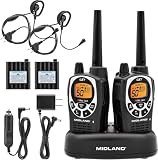 | Midland GXT1000VP4 GMRS Two-Way Radio (50 Channel, Long Range, 142 Privacy Codes, SOS, NOAA, Rechargeable Nickel Battery, Black/Silver 2-Pack) | Check Price On Amazon |
 | Retevis RT628 Walkie Talkies for Kids,Toys Gifts for 6-12 Years Old Boys Girls,Long Range 2 Way Radio 22CH VOX,Birthday Gift,Family Walkie Talkie for Camping Hiking Indoor Outdoor | Check Price On Amazon |